 Rent-Try-Buy
With SilverChef |
Apply Now


Commercial Hot Plates vs Gas Cooktops: Which Suits Your Menu?
13
Nov
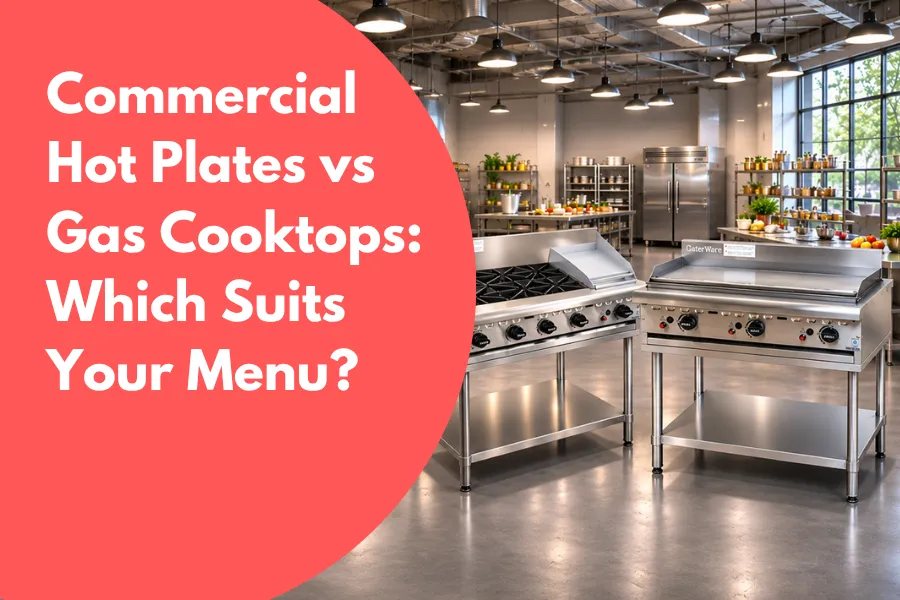
Commercial hot plates vs gas cooktops comes down to how your kitchen prepares food, how many dishes need cooking at once and the space available on your cooking line. A flat hotplate cooks food directly against a heated surface, while an open-burner cooktop heats pots and pans.
A café preparing eggs, bacon and burger patties may benefit from a dedicated hotplate. A restaurant serving pasta, soups and sautéed dishes will usually need burners. Kitchens preparing both types of food regularly may find a combination appliance more practical.
Both types of equipment can be gas-fired. The CaterWare models compared here use natural gas or LPG, so the main decision is about cooking method and configuration rather than gas versus electricity.
How Hotplates and Gas Cooktops Differ
The main difference is how heat reaches the food. A commercial hotplate provides a flat metal surface for direct-contact cooking. An open-burner cooktop transfers heat through cookware positioned above individual gas burners.
This affects the dishes staff can prepare, how they organise cooking tasks and how much equipment space is available during a busy service.
What a Commercial Hotplate Does Best
Commercial flat hotplates, also called griddles, suit foods that benefit from direct contact with a heated cooking surface.
Typical applications include burger patties, bacon, eggs, pancakes, sausages, flatbreads and suitable vegetables. Staff can arrange several portions across the plate without using a separate frying pan for each order.
For a breakfast café, this may provide a practical way to cook eggs, bacon and pancakes during the same service period. A burger kitchen may use the flat surface for patties, onions and other suitable ingredients.
The available plate area determines how much food can be cooked comfortably at once. Staff still need room to turn and remove portions, manage different cooking temperatures and prevent cross-contamination.
A compact hotplate may suit a limited menu or secondary station, while a wider surface may be necessary when several orders need preparing together.
Where a Commercial Gas Cooktop Works Better
A commercial gas cooktop uses individual burners to heat compatible pots, pans and other cooking vessels.
This arrangement suits boiling pasta, simmering soups and sauces, sautéing vegetables, pan-frying proteins and preparing dishes that need separate cooking vessels.
For example, a restaurant may keep a sauce simmering on one burner while preparing vegetables in a frying pan on another. Each burner provides an individual cooking position, allowing staff to manage different cooking times.
The number and spacing of burners affect how many tasks can run together. A large stockpot may occupy more room than a small saucepan, and wide cookware can restrict access to neighbouring burners.
For kitchens that regularly prepare several pan-based dishes, burner availability is often more important than the appliance’s overall width.
Commercial Hotplates vs Gas Cooktops: Comparison
The most useful comparison is how each appliance supports your menu and the work that takes place during peak service.
| Consideration | Commercial flat hotplate | Commercial gas cooktop |
| Cooking method | Food cooks directly on a heated metal plate | Heat transfers through pots and pans |
| Typical dishes | Burgers, bacon, eggs, pancakes and flatbreads | Pasta, sauces, soups and sautéed dishes |
| Cookware | Usually unnecessary for direct-plate cooking | Compatible cookware required |
| Cooking positions | Shared flat cooking surface | Individual gas burners |
| Practical capacity | Usable plate area and food spacing | Burner number, spacing and cookware |
| Heat control | Depends on plate design and control zones | Individual burner controls |
| Cleaning | Plate surface, grease tray and surrounding areas | Burners, trivets and spill areas |
| Main limitation | Cannot replace pots for boiling or simmering liquids | Multiple pans can occupy valuable burner positions |
Neither arrangement replaces every function of the other.
A gas cooktop can cook burger patties in frying pans, but preparing several portions this way may occupy multiple burners. A flat hotplate can handle suitable meats and vegetables but cannot replace a stockpot for boiling pasta or preparing large quantities of soup.
If your menu regularly needs both cooking methods, a combined hotplate and burner configuration is worth considering.
Match Your Cooking Equipment to Your Menu
The number of dishes on your menu is less useful than knowing which cooking tasks happen at the same time.
A café may have a relatively short menu but receive many breakfast orders together. A restaurant might offer numerous dishes while needing only a few burners during quieter periods.
Look at the cooking activities that overlap during your busiest service and identify where staff regularly run short of cooking space.
Why Hotplates Suit Breakfast and Burger Kitchens
A flat hotplate gives staff a shared surface for cooking suitable breakfast foods and burger ingredients.
A café might prepare eggs, bacon, sausages and pancakes across the plate, allowing for the different temperatures and handling requirements of each food. A takeaway kitchen can use the same arrangement for burger patties and onions.
Our CaterWare Hotplate/Griddle with Stand 300mm (CW-HP30) provides a compact example. It has a 20mm heavy-gauge polished steel plate, a grease collection tray and natural gas or LPG configurations.
Its nominal 300mm format may suit a smaller cooking station. However, a kitchen preparing multiple burger orders at once needs to consider whether the usable plate area can accommodate the required portions.
Cooking capacity must also be considered alongside food safety. Food Standards Australia New Zealand’s processing guidance recommends cooking chicken and minced meat to an internal temperature of at least 75°C as an example of a safe cooking process. This is particularly relevant when preparing burger patties, regardless of whether the kitchen uses a hotplate or frying pan.
Use a suitable food thermometer to check the required internal temperature rather than judging food safety from surface colour alone.
Why Gas Cooktops Suit Sauces, Soups and Pan-Based Cooking
A gas cooktop is generally more useful when a substantial part of your menu requires saucepans, frying pans or stockpots.
Restaurants preparing pasta, soups, sauces and sautéed dishes need cooking positions that accommodate different vessels and preparation times. Some burners may remain occupied by simmering food while others are needed for shorter cooking tasks.
Our CaterWare 2 Burner Gas Cooktop with Stand (GB2) provides two separate cooking positions with individual burner controls and reversible enamelled trivets.
Two burners may be sufficient for a smaller kitchen or a dedicated sauce station. If staff regularly need several pots and pans during peak service, a larger configuration may prevent cooking positions from becoming a bottleneck.
Count the vessels that need heat simultaneously, including those occupied by sauces or stocks that remain on the cooktop for extended periods.
When a Combination Unit Makes More Sense
Kitchens preparing both flat-plate foods and pan-based dishes may benefit from a combined appliance.
A café might cook breakfast items on a hotplate while using a burner for sauces. A pub kitchen could prepare burgers on the plate while keeping separate pots or pans available for other menu items.
Our CaterWare 2 Burner Gas Cooktop with 600mm Hotplate (GB2-60HP) combines two open gas burners with a 600mm hotplate configuration.
The burners and flat plate can be used during the same service, providing separate positions for direct-contact and cookware-based preparation.
A combined unit still has capacity limits. If two burners are regularly occupied and the hotplate is full, staff may need more cooking space. The practical test is whether the configuration accommodates your normal peak workload.
Cooking Surfaces and Cookware Compatibility
Even when an appliance provides suitable heating capacity, its physical arrangement must accommodate the food and cookware used in your kitchen.
Compare usable cooking dimensions, plate construction, burner spacing and the room needed for safe handling.
Cooking Directly on a Commercial Hotplate
The cooking plate is the working surface of a flat-top griddle, so its dimensions and construction deserve attention.
The CaterWare CW-HP30 has a published 20mm heavy-gauge polished steel plate. A substantial cooking plate can retain heat, although actual heat distribution and temperature recovery depend on the full appliance design and operating conditions.
Consider the size and number of portions you need to cook together. Large burger patties require room for turning, while breakfast dishes may need different cooking times and temperatures.
Look at the available cooking area and control arrangement rather than relying only on the appliance’s nominal width.
The CW-HP30’s 300mm designation does not, by itself, establish the exact usable plate dimensions. Those should be checked against the current product drawing when cooking area is a deciding factor.
Matching Pots and Pans to Commercial Gas Burners
Gas cooktops support cookware above the burners using trivets or similar components. The arrangement affects the size and number of vessels that can be used safely.
The CaterWare GB2 has reversible enamelled trivets and two individually controlled burners. Compare the manufacturer’s cookware requirements with the pots and pans used in your kitchen.
A large stockpot may need more room than a saucepan, and wide cookware can interfere with access to the neighbouring burner. Filled vessels also require suitable support and enough clearance for staff to handle them safely.
Two burners do not automatically mean that two large cooking vessels will fit comfortably together.
Check the actual cookware arrangement, particularly if the cooktop will be used for several tasks during busy service.
Cleaning and Maintaining Hotplates and Gas Cooktops
Both types of equipment need routine cleaning, but the work involves different surfaces.
Flat hotplates collect grease and cooking residue directly on the plate. Gas cooktops collect spills around burners, trivets and the surfaces beneath cookware.
The cleaning workload depends on the food being prepared, the appliance design and the manufacturer’s maintenance instructions.
Cleaning a Flat Hotplate After Service
Grease, food residue and cooking deposits build up on a hotplate during use. Staff may need to clear residue between suitable cooking tasks, followed by a more thorough clean after service.
The CaterWare CW-HP30 includes a grease collection tray. This needs regular emptying and cleaning, together with the cooking plate and accessible surrounding surfaces.
Follow the manufacturer’s instructions for cleaning the plate material and finish. Unsuitable scrapers or chemicals may damage the cooking surface.
Consider how easily staff can reach the plate and grease tray when positioning the appliance. Equipment that is difficult to access may require additional cleaning time.
Cleaning Gas Burners, Trivets and Spill Areas
Open-burner cooktops collect residue around the burners and under cooking vessels. Boil-overs, sauces and food particles can make these areas harder to clean.
The CaterWare GB2 uses enamelled trivets and has accessible cooking surfaces. Routine cleaning should follow the manufacturer’s instructions for removing and cleaning approved components.
Staff should not dismantle gas connections or other service components during ordinary cleaning.
If a burner becomes difficult to ignite, operates abnormally or appears damaged, arrange an inspection by an appropriately qualified technician.
Neither cooking arrangement is automatically easier to maintain. Consider the foods being prepared and the cleaning work each appliance will require.
Check Cooking-Line Space and Installation Requirements
Commercial cooking equipment must fit within the available kitchen layout while leaving staff room to handle food, move cookware and clean surrounding surfaces.
Overall dimensions provide a starting point, but the usable cooking space and working clearance also need consideration.
How Hotplate Width Affects Cooking Capacity
Hotplate width affects the number of portions that can be arranged on the surface, although the available cooking area is not always identical to the appliance’s nominal dimensions.
The CaterWare CW-HP30 has published overall dimensions of 315 × 800 × 1095mm, including its stand.
Its nominal 300mm hotplate format may suit a narrow workstation, but it provides a different cooking arrangement from a wider griddle. If several burger or breakfast orders must cook together, the smaller plate may become restrictive.
Compare the actual plate area with the required portions and allow room for safe turning and removal.
Also consider the space needed beside the appliance for utensils, plates and food preparation. A cooking line should support the complete task, not simply accommodate the equipment footprint.
Why Burner Count Depends on Simultaneous Cooking
Burner count should reflect the pots and pans that need heat at the same time.
A smaller café may require only two burners for occasional sauces or boiling. A restaurant preparing numerous pan-based dishes may need more positions, particularly if some remain occupied by long-running cooking processes.
The CaterWare GB2 has published overall dimensions of 315 × 800 × 1095mm, including its stand. Its two burners provide separate positions, but the available cookware space should be checked before selecting it for large pots.
For a broader comparison of burner configurations, read our 2 Burner vs 6 Burner Commercial Gas Cooktops Guide.
The aim is to match burner capacity with actual service demand rather than selecting the largest appliance that will fit.
Confirm Gas Supply, Ventilation and Installation
All three CaterWare appliances featured in this comparison are gas-fired.
They are available in natural gas and LPG configurations, so the selected fuel type must match the premises and the appliance supplied.
The CW-HP30 has a published 27 MJ/h burner rating. The GB2 lists 30 MJ/h per burner, while the GB2-60HP lists total gas inputs of 102 MJ/h for natural gas and 96 MJ/h for LPG.
These ratings describe gas input, not cooking throughput or the capacity of an existing gas supply.
An appropriately licensed gasfitter should assess supply capacity, connections and any required modifications. Ventilation, extraction, installation clearances and servicing access also need to be checked against the appliance’s instructions and applicable requirements.
Allow for these checks before ordering, particularly if replacing a smaller unit with higher-input equipment.
Which CaterWare Cooking Setup Should You Choose?
Our commercial cooking equipment range includes dedicated hotplates, open-burner cooktops and combination units.
The CW-HP30, GB2 and GB2-60HP offer three arrangements for different kitchen requirements. The most suitable choice depends on the cooking method used most often and whether the appliance can accommodate peak service.
CaterWare CW-HP30: Compact Flat Hotplate
The CaterWare Hotplate/Griddle with Stand 300mm (CW-HP30) provides a dedicated flat surface for direct-contact cooking.
It has a 20mm polished steel plate, grease tray, piezo ignition and flame-failure protection. The unit includes a stand and is available in natural gas or LPG configurations.
Consider the CW-HP30 when your kitchen needs a compact hotplate for eggs, bacon, burger patties or similar foods, and the usable plate area can accommodate the required portions.
If flat-plate cooking dominates your busiest service periods, compare the smaller model with wider hotplates before ordering.
CaterWare GB2: Two Open Gas Burners
The CaterWare 2 Burner Gas Cooktop with Stand (GB2) provides two cooking positions for suitable pots and pans.
Its published features include reversible enamelled trivets, individual controls, flame-failure protection and a stand. Natural gas and LPG versions are available.
Consider the GB2 when most of your cooking requires pots and pans and two burner positions are sufficient for the dishes prepared at the same time.
For kitchens where several sauces, stocks or pan-cooked dishes regularly compete for space, a larger burner configuration may be more practical.
CaterWare GB2-60HP: Flat Hotplate and Burners Combined
The CaterWare 2 Burner Gas Cooktop with 600mm Hotplate (GB2-60HP) combines two open burners with a 600mm hotplate configuration.
Its published overall dimensions are 915 × 800 × 1095mm. The unit includes a stand with an under-shelf, flame-failure protection and natural gas or LPG options.
Consider the GB2-60HP when staff regularly need a flat cooking surface and separate burner positions during the same service period.
It can suit mixed menus, but check that the hotplate area and two burners provide enough capacity for the busiest part of your trading day.
Commercial Hotplate and Gas Cooktop Buying Checklist
Before selecting equipment, review the main requirements against your kitchen’s menu and available space.
- Cooking methods: Identify which dishes need direct-contact cooking and which require pots or pans.
- Peak workload: Count the portions and cooking vessels that need heat simultaneously.
- Usable capacity: Check the cooking plate area, burner spacing and cookware compatibility.
- Kitchen layout: Compare overall dimensions with the available cooking-line space and staff access requirements.
- Installation: Confirm gas type, supply capacity, ventilation, clearances and any necessary professional work.
- Daily operation: Review cleaning, grease management, maintenance and access to service points.
- Budget: Compare equipment prices with delivery and any required installation modifications.
Commercial Hotplate vs Gas Cooktop FAQs
Is a Commercial Hotplate Better for a Breakfast Café?
A flat hotplate can be a practical choice for breakfast menus built around eggs, bacon, sausages and pancakes. It provides a shared cooking surface for suitable foods.
If the kitchen also prepares sauces, soups or other pan-based dishes, open burners may still be needed.
Can I Cook Burgers and Steaks on a Commercial Hotplate?
Yes. Flat hotplates can be used for burger patties and suitable steak preparations.
Cooking results depend on plate temperature, food thickness and technique. Follow the relevant food-safety requirements, including checking safe internal temperatures where appropriate.
Can a Gas Cooktop Replace a Flat Hotplate?
A gas cooktop can prepare some of the same foods using frying pans, but it does not provide a shared flat cooking surface.
For a kitchen preparing many burger patties at once, separate pans may occupy valuable burner positions. A dedicated hotplate may be more practical.
Are Hotplates Easier to Clean Than Gas Cooktops?
Not necessarily. Hotplates collect grease and residue on their cooking surfaces, while gas cooktops need cleaning around burners, trivets and spill areas.
Cleaning requirements depend on the appliance and the food prepared.
Do Commercial Hotplates Use Gas or Electricity?
Commercial hotplates are available with different energy sources. The CaterWare CW-HP30 discussed here is gas-fired and offered in natural gas and LPG configurations.
Check the selected appliance’s specifications before planning the installation.
Should I Choose Separate Equipment or a Combination Unit?
A combination unit may suit kitchens that regularly need direct-contact cooking and open burners during the same service period.
Separate appliances may provide greater flexibility in positioning or capacity. Compare the required cooking space, available layout and installation work before deciding.
Find a Commercial Cooking Setup That Fits Your Menu
The best choice between a commercial hotplate, gas cooktop or combination unit depends on how your kitchen prepares food during its busiest periods.
A flat hotplate may be the better choice when direct-contact cooking dominates the menu. Open burners are useful where staff rely on pots and pans, while a combination appliance can accommodate both cooking methods in one workstation.
Browse our commercial cooking equipment range to compare available models.
If you need help choosing, contact the Caterware team with your menu, available cooking-line dimensions, gas type and the number of portions or cooking vessels used during peak service. We can help you compare the product configurations and identify the installation details to confirm before ordering.